Showing posts with label Theology. Show all posts

Mark Driscoll - Proverbs and Planning

1 comments

I need this. How about you?
My Zimbio
Top Stories

Decisional Regeneration: Paul Washer Interview

0 comments
My Zimbio
Top Stories

Chuck Swindoll's Pastoral Accountability Questions

0 comments
Chuck Swindoll's Pastoral Accountability Questions:


In his book, The Body, Chuck Colson lists the questions used by Chuck Swindoll.

1. Have you been with a woman anywhere this past week that might be seen as compromising?
2. Have any of your financial dealings lacked integrity?
3. Have you exposed yourself to any sexually explicit material?
4. Have you spent adequate time in Bible study and prayer?
5. Have you given priority time to your family?
6. Have you fulfilled the mandates of your calling?
7. Have you just lied to me?
My Zimbio
Top Stories

David Lowe on Jonathan Edwards' Sermon

0 comments
Judge for yourself. Click on title to hear Sermon


I have a friend named David. Wet met online some 5 years ago, when I was very much into End Times theology, and waiting for the rapture to occur. I was doing a Google search for a Pastor named Perry Stone (who we both no longer listen to incidentally), and David's website came up. David and I remain friends till this day, but our friendship has become a little distant when we both adhered to opposite ends of the theological rope, so to speak. I became reformed in my understand of scripture, while David gravitated towards Arminian theology. The changed occurred this way:

David asked me once, "what will you say to a person who asks, 'why will I be judged by God if I was born with a condition that makes me love what God hates - speaking of sin - and born when I didn't ask to be born?'" I remember that the question had little effect on me, initially. I gave a flippant response; something like..."disregard the question, and tell him how he has broken God's laws to bring about an awareness of his sins." Yet, as time went on, the question began to strike me as one with weight. I couldn't shake the feeling that if such a question was posed, the questionnaire would have a great point. For months the question pressed on my mind and conscience, until I became angry with God. The question made God seem unfair and at fault for countless sinners going to hell's infinite torment. Yet, ironically enough, it was that question that lead me to a closer relationship with God. Needless to say, today Dave and I have some disagreements on how we see certain scriptures. This brings me to the point of my blog. Recently, while speaking about Jonathan Edward's famous Sermon, "Sinners in the Hands of an Angry God," Dave said the following:

"I don't like the sermon because it is not biblical. It is not in the Spirit of Christ. It uses fear and manipulation to get people to repent. This is not how Jesus and the apostles preached. It leads to false conversions based on a fear of burning in hell forever. Rather, conversion should be based on the gospel: that Jesus Christ conquered death, died for our sins, and is exalted at the right hand of God. He commands all men everywhere to repent."

My aim in this blog isn't to defend Edward's work (I feel it does a good enough job on its own merit), but simply to address some of the comments and concerns that Dave brings up as his argument. With that being established, let us continue on in the endeavor at hand. First, on the issue of the sermon "using fear and manipulation to get people to repent." This statement assumes that Jesus or scripture for that matter, never uses fear as one of many motivators in leading someone to Christ. This simply isn't true. The scriptures clearly say..." by the fear of the LORD one turns away from evil" (Proverb 16:6). And lest one would say, "but that is the Old Testament - Jesus never taught this," as if it were a valid argument, we would do well to remember Christ' words... "I will show you who to fear. Fear him who can destroy both soul and body in hell" (Matt 10:28). I trust that these scriptures will suffice in showing that the premise for David's conclusion is faulty. And since the premise is as such, the conclusion no doubt will be in error. Second, concerning Dave's feelings that the sermon will "leads to false conversions based on a fear of burning in hell forever."

I feel this to be a legitimate argument; partly because I know Dave's heart in evangelism, and because fear could be a potential stumbling block if it is used wrongly. I think if one uses fear of hell without first explaining man's guilt, and then explaining Christ' glory in saving us from such a place, a person could in fact get the wrong idea, and thus end up being a false convert. I myself had experience with this. Some time before my conversion, I heard about the rapture and the Great Tribulation, and so I reformed my life to ensure that I wouldn't be left behind. Yet, I was in no way born again. In fact, I didn't even understand why Jesus was so precious, or why God would call me - and otherwise good boy - an evil person. So with all that being said, I want to acknowledge David's concern. Nevertheless, this concern does still stem from a false assumption (one we already dealt with above), and therefore should not deter believers from using the fear that should arise from preaching the realities of God's wrath in Hell. Finally, I think it worthwhile to mention my conjecture on this issue. I believe that Dave's contention with such a classic sermon, derives from a livid disdain for Calvinism. And because this is so - if in fact this is the case - then nothing I say will change his mind.
Its cool though, Dave...you're still my dude!


My Zimbio
Top Stories

Weeping Over the Sovereignty of God - John Piper

0 comments
My Zimbio
Top Stories

Does God Create Evil?

1 comments
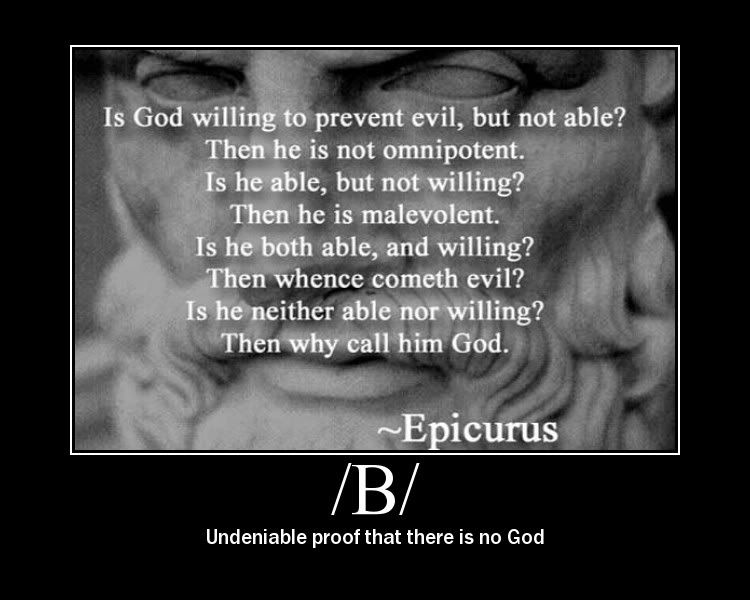
One of the most common reasons why skeptics reject the reality of God, is due to the problem of evil in the world. The question that is often posed by the philosophers and atheists alike is, "how can an omnibenevolent and omnipotent God allow evil?" If he is infinitely perfect and infinitely strong, they reason, he cannot allow evil. You see, in the mind of one who would ask the aforementioned question, God's omnipotence cannot be reconciled with his omnibenevolence, as they are mutually exclusive. If he is truly good, he cannot allow evil to exist. And, since evil does exist, and if God is truly good, he cannot then be infinitely strong (since he being good, would stop sufferings). Such seemingly paradoxical statements award sufficing reason to altogether disregard a deity - especially the Christian representation of God. And yet, this is to be expected from the unbeliever. Scripturally speaking, all unbelievers are "defiled in their mind and consciences" (Titus 1:15), insomuch that "they are unable to believe spiritual truth because it is foolishness to them" (1 Cor 2:14). Therefore, for the rest of this post, I will seek to speak specifically to believers. The aim in this blog isn't to present a case for God to the unbeliever, but instead to give believers an explanation to the question, "does God create evil?"

"I form the light, and create darkness: I make peace, and create evil: I the LORD do all these things" (Isa 45:7)

Before I can go on to give an explaination to this scripture, it will do well to lay some foundation. It must be seen at the outset, that the Bible is not a book written in 21th century American English, but rather two dead languages primarily; namely Hebrew and Greek. Therefore, my first point would be simply to point to exegesis. In this case, "what does evil mean in this particular scripture?" The word translated evil here, is the Hebrew word "ra raah." Its meanings are as followed: evil, distress, calamity, misery, grief. Note, therefore, that the word evil could rightly be translated as any one of the other meanings and keep its integrity and accuracy. In fact, the English Standard Version, for example, translates the word evil with "calamity," as do many other accepted translations. That being said, however, simple exegesis alone will not suffice in answering the question. If indeed God does make evil, as some might believe, there must be a central interpretative motif or theme that proves it in the scriptures.

While the scriptures clearly teach that God "creates evil" (Isa 45:7), "brings about calamity...and disaster" (Lam 3:37-38, Amos 3:6), and gives "bad times, as well as the good" (Ecc 7:13), should we then see God as an omnipotent megalomaniac? If we do, we are certain to run into some clear contradictions. Consider for example, three scriptures (there are many more, but for brevity's sake, I will refrain):

"The Rock, his work is perfect, for all his ways are justice. A God of faithfulness and without iniquity, just and upright is he" (Deu 32:4).

"This is the message we have heard from him and proclaim to you, that God is light, and in him is no darkness at all" (1 John 1:5).

"For you are not a God who delights in wickedness; evil may not dwell with you" (Psa 5:4).

Let's analyze some important facts:

1. God's work is perfect and altogether just (Deu 32:4)
2. God does not delight in wickedness (Psa 5:4)
3. God is light (perfect light/love/goodness), and there is NO darkness (evil) in him (1 Jn 1:5)

If you are a believer, you know that there are no contradictions in scripture, and therefore I will not spend time on that issue. Still, however, if you believe that God does create evil, you have come into a problem of contradictions. Does God create evil in the sense you assume, or is his ways altogether perfect and without evil? You cannot have it both ways, as indeed the two opinions are at odds and against a fundamental law of logic; namely the law of non contradiction. Now that we are presented with these contradictions, and as a result forced to remove ourselves from the presuppositions that keep us myopic, we will better deal with what scripture teaches (as apposed to having our opinions dictate what scripture actually say). What then does the bible mean when it says that "God 'creates' evil?" First, let it be said that evil is not a "created" thing. What I simply mean, is that you can't see, touch, feel, smell or hear evil. It is not one of the fundamental forces of physics, nor does it consist of matter, energy, or the spatial dimensions of the universe. Therefore, for my 1st argument against God creating evil, I would simply pose the "Absence Theodicy Argument."

In the same way "cold" is the absence of "heat," and "darkness" is the absence of "light,"I submit that evil is the absence of God. But how do we know that cold is the absence of heat, and darkness is the absence of light? First, concerning cold, we know that according to the laws of Physics, cold is in fact the absence of heat. Anything is able to be studied as long as it transmit energy (heat). Absolute Zero is the total absence of heat, but cold does not exist. What we have done is create a term to describe how we feel if we don't have body heat, or if we are not hot. And, as far as darkness is concerned, we know that light can be studied and darkness cannot. Darkness cannot be broken down. A simply ray of light, for example, tears the darkness and illuminates the surface where the light beam finishes. Dark is simply a term we use to describe what happens when there is a lack of light. Again - as its been said before - just as cold is the absence of heat and darkness is the absence of light, evil is the absence of good; albeit the greatness good, namely God himself.

Finally, I want to switch from a philosophical argument, to more of a theological one. The problem with God creating evil, as some believe, is a moral issue dealing with God's character, and therefore we must seek the scriptures to see what it says. Does Isaiah 45:7 teach that God creates evil in the same sense men might? First of all, the verse can have no reference to moral evil (wickedness) for such is opposed to the infinitely holy nature of God (Isaiah 6:3). Jehovah is a “God of faithfulness and without iniquity”(Deuteronomy 32:4). He is “not a God that hath pleasure in wickedness” (Psalm 5:4). Nor can it be supposed that this verse has to do with Jehovah’s original creation, for at the termination of the creation week, the Lord saw “everything that he had made, and, behold, it was very good” (Genesis 1:31). Then how might we understand the verse? The verse may well be understood in fact that:

1. whatever God does - whether we perceive it to be a calamity or altogether evil - is right and therefore good, since all the Lord does is good (Deu 32:4, Job 34:10).
2. God often uses the evil acts of free moral agents to bring about punishment or judgment, while yet remaining the one who is not the author of evil. Note for example, the case of Joseph's brothers who sold him into slavery, and years later where Joseph testifies..."it is not you who sent me here, but God."
My Zimbio
Top Stories

Can a Christian commit suicide? - Tim Conway

1 comments
My Zimbio
Top Stories

Paul Washer Interview

0 comments


Please stop and watch brother Paul's interview, as he speaks on the importance of doctrine and theology.
My Zimbio
Top Stories

Do You Desire God? - Paul Washer

0 comments
My Zimbio
Top Stories

Can I Lose My Salvation? - Doug Eaton

0 comments


"For I have come down from heaven, not to do my own will but the will of him who sent me. And this is the will of him who sent me, that I should lose nothing of all that he has given me, but raise it up on the last day" (John 6:38-39).
My Zimbio
Top Stories

The Wonder of it All - Jeff Noblit

0 comments
My Zimbio
Top Stories

Theology Hinges on Sovereignty Of God

0 comments

Theology Hinges on Sovereignty Of God

Covers wide range of beliefs; critics say it minimizes role of free will.

Published: Thursday, July 23, 2009 at 11:25 p.m.
Last Modified: Thursday, July 23, 2009 at 11:24 p.m.

John Calvin's theology is dominated by the doctrine that God is "sovereign," or rules over everything in creation, down to the most minute detail.

It can be found in varying degrees today in Presbyterian and Baptist churches, in the Reformed Church in America and Christian Reformed Church that have roots in the Netherlands and in the United Church of Christ, which absorbed the Congregationalist churches founded by the Puritans.

Calvinism covers a wide range of beliefs, but the version best known in the Netherlands, Scotland and America is summarized by five principles, known by the acronym TULIP, that address the question of salvation. Critics of five-point Calvinism complain that it removes or diminishes the role of human free will.

Total depravity: Not a belief that persons are completely corrupt but rather that all parts of a person - reason, emotions and beliefs - are affected by sin. People are therefore incapable of belief in God without God's help.

Unconditional election: Sometimes known as predestination, it is the belief that God has chosen those who will be saved. It is a claim that humans cannot earn or accomplish their own salvation.

Limited atonement: The belief that Christ did not die for all humanity, only for those who are "elect," or chosen to be saved.

Irresistible grace: This holds that those chosen by God will inevitably come to believe in him.

Perseverance of the Saints: Calvinism teaches that those who have been saved by God cannot lose their salvation but will persevere until the final judgment.

My Zimbio
Top Stories

Terrence and Tynia Talk about Calvinism pt 1

1 comments
My Zimbio
Top Stories

What God Showed Me Today

0 comments
"Indeed, I count everything as loss because of the surpassing worth of knowing Christ Jesus my Lord. For his sake I have suffered the loss of all things and count them as rubbish, in order that I may gain Christ..." (Philippians 3:8-9).

Tonight I had a chance to speak to a friend about what it means to be justified by faith in Jesus, and as we spoke on the subject, God graciously worked on both our hearts. For me, as I began to think about being justified, I was instantly reminded by some scriptures and there implications for me. Here's a small summary of my thoughts:

I have been born again because all my hope and trust is in Jesus (John 1:12). Because I trust in Jesus, I am justified insomuch that "there is now, therefore, no condemnation for me" (Romans 8:1). God loves me just as he loves his Son Jesus, in whom he is well pleased (John 17:23). I exist by God and "for God" (Col 1:16). Presently in my life, I do not want to be married and I have contentment in singleness (though I'd like to get married sometime in the future), therefore I should not waste time thinking about what I do not have; especially considering that the Sovereign God of the universe has given me a sense of contentment. I should aim hard at pleasing God where he has me, and be faithful.

The following scripture also came to mind. It was both convicting and encouraging:

"What causes quarrels and what causes fights among you? Is it not this, that your passions are at war within you? You desire and do not have, so you murder. You covet and cannot obtain, so you fight and quarrel. You do not have, because you do not ask. You ask and do not receive, because you ask wrongly, to spend it on your passions..."(James 4:1-3).


Oh help me in this Father, please!! My Zimbio
Top Stories

Shai Linne - Mission Accomplished

0 comments


Particular Redemption Rap.
My Zimbio
Top Stories

Paul Washer on God's Election

2 comments


This is a pretty cool video
My Zimbio
Top Stories

God's Guidance - Brent Brewer

0 comments
My Zimbio
Top Stories

Blog Update ("I'm Still A Stupid Calvinist!")

1 comments
<----Stupid Calvinist Boy

Here's my update:


Remember February's post about me looking for a good enough argument to disregard my branch of theology as good sounding lies (
see it here)? Well, I'm sorry to report that I'm still the dreaded "C" word. Yes, you've guessed it, I'm still "childish." Also noteworthy - and more relevant to the context of this post - I am still a Calvinist as well. Okay guys, you "Calvinism is evil" type people (some of you exist as dear brothers and sisters in the faith), you need to know that misnomers, cliches' and caricatures, just aren't going to do it for me. I'm going to need more convincing...and from scripture, please! My Zimbio
Top Stories

The Message God Used to Save Me

0 comments

"The law of the LORD is perfect, reviving the soul; the testimony of the LORD is sure, making wise the simple" (Psalm 19:7).

I
t has now been 6 years, and I'm just beginning to see how amazing my conversion was. Oh there is so much to tell! So much to say of my presumed position in God, because of my assumptions that I was a good person. I will not write of them now, but you may ask me if you see me! This post is just a reminder of God's goodness and mercy; how though hearing a message geared for teaching Christians how to share their faith, a sinner heard and believed unto salvation. I still remember what I said that night in my room: "Oh...this is what Christianity is about?" Prior to that message, I didn't understand why Jesus died (though I would say "for the sins of the world"). After that message, I could say with Paul the Apostle..."I would have not known sin but by the law," and again..."the law was my school master in leading me to Christ."


Father - thank you for letting me understand the message of the gospel, and for making it the sweetest thing I ever heard! Make me to obey you more, for this is my reasonable sacrifice! My Zimbio
Top Stories

Pastor Steve - American Idolatry Sermon

2 comments
My Zimbio
Top Stories
 

A Pilgrim's Progress: My Life as a Christian.