

I need this. How about you?

Top Stories


 I feel this to be a legitimate argument; partly because I know Dave's heart in evangelism, and because fear could be a potential stumbling block if it is used wrongly. I think if one uses fear of hell without first explaining man's guilt, and then explaining Christ' glory in saving us from such a place, a person could in fact get the wrong idea, and thus end up being a false convert. I myself had experience with this. Some time before my conversion, I heard about the rapture and the Great Tribulation, and so I reformed my life to ensure that I wouldn't be left behind. Yet, I was in no way born again. In fact, I didn't even understand why Jesus was so precious, or why God would call me - and otherwise good boy - an evil person. So with all that being said, I want to acknowledge David's concern. Nevertheless, this concern does still stem from a false assumption (one we already dealt with above), and therefore should not deter believers from using the fear that should arise from preaching the realities of God's wrath in Hell. Finally, I think it worthwhile to mention my conjecture on this issue. I believe that Dave's contention with such a classic sermon, derives from a livid disdain for Calvinism. And because this is so - if in fact this is the case - then nothing I say will change his mind.
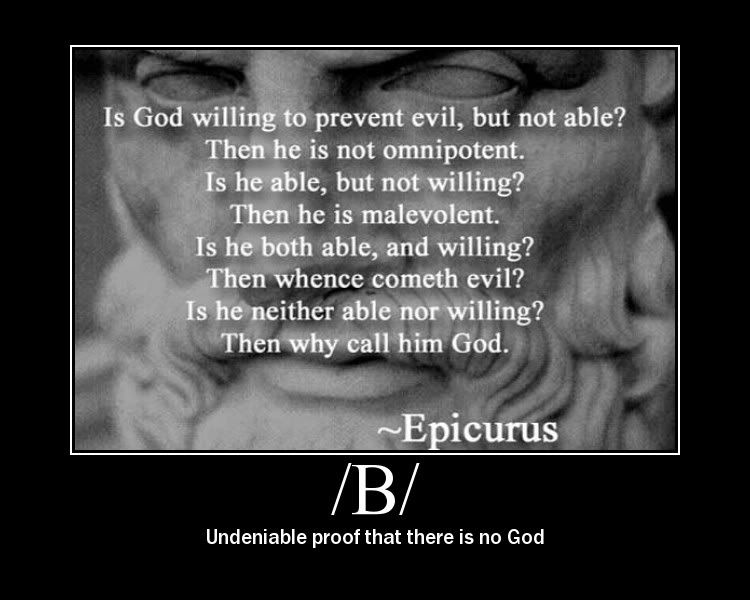 One of the most common reasons why skeptics reject the reality of God, is due to the problem of evil in the world. The question that is often posed by the philosophers and atheists alike is, "how can an omnibenevolent and omnipotent God allow evil?" If he is infinitely perfect and infinitely strong, they reason, he cannot allow evil. You see, in the mind of one who would ask the aforementioned question, God's omnipotence cannot be reconciled with his omnibenevolence, as they are mutually exclusive. If he is truly good, he cannot allow evil to exist. And, since evil does exist, and if God is truly good, he cannot then be infinitely strong (since he being good, would stop sufferings). Such seemingly paradoxical statements award sufficing reason to altogether disregard a deity - especially the Christian representation of God. And yet, this is to be expected from the unbeliever. Scripturally speaking, all unbelievers are "defiled in their mind and consciences" (Titus 1:15), insomuch that "they are unable to believe spiritual truth because it is foolishness to them" (1 Cor 2:14). Therefore, for the rest of this post, I will seek to speak specifically to believers. The aim in this blog isn't to present a case for God to the unbeliever, but instead to give believers an explanation to the question, "does God create evil?"
John Calvin's theology is dominated by the doctrine that God is "sovereign," or rules over everything in creation, down to the most minute detail.
 in varying degrees today in Presbyterian and Baptist churches, in the Reformed Church in America and Christian Reformed Church that have roots in the Netherlands and in the United Church of Christ, which absorbed the Congregationalist churches founded by the Puritans.
Calvinism covers a wide range of beliefs, but the version best known in the Netherlands, Scotland and America is summarized by five principles, known by the acronym TULIP, that address the question of salvation. Critics of five-point Calvinism complain that it removes or diminishes the role of human free will.
Total depravity: Not a belief that persons are completely corrupt but rather that all parts of a person - reason, emotions and beliefs - are affected by sin. People are therefore incapable of belief in God without God's help.
Unconditional election: Sometimes known as predestination, it is the belief that God has chosen those who will be saved. It is a claim that humans cannot earn or accomplish their own salvation.
Limited atonement: The belief that Christ did not die for all humanity, only for those who are "elect," or chosen to be saved.
Irresistible grace: This holds that those chosen by God will inevitably come to believe in him.
Perseverance of the Saints: Calvinism teaches that those who have been saved by God cannot lose their salvation but will persevere until the final judgment.
 "Indeed, I count everything as loss because of the surpassing worth of knowing Christ Jesus my Lord. For his sake I have suffered the loss of all things and count them as rubbish, in order that I may gain Christ..." (Philippians 3:8-9).
 <----Stupid Calvinist Boy
 Posts
All Comments
Posts
All Comments


